What the study asked
UBT251 is a once-weekly subcutaneous agonist of GLP-1, GIP, and glucagon receptors. This multicenter, randomized, double-blind, parallel phase 2 study asked how body weight changed after 24 weeks in adults with overweight or obesity without type 2 diabetes. It did not test UBT251 against another active drug.
The study enrolled 205 participants in China. The paper describes 25 centers. The registry names The United Bio-Technology (Hengqin) Co., Ltd. as sponsor. Randomization was 2:1:1:2:2 across the active regimens and placebo; the table below preserves the separate starting-regimen groups.
Who was included
Registry eligibility covered ages 18–75, with BMI ≥28.0 kg/m², or 24.0 ≤ BMI <28.0 with specified comorbidities, using Chinese criteria. The paper summary describes enrolled participants aged 18–61 and 59.0% women. Eligibility and the observed sample are different descriptions, so neither age range should silently replace the other.
Type 2 diabetes was excluded. Results should not be merged with those from the separate diabetes study.
Reading the headline
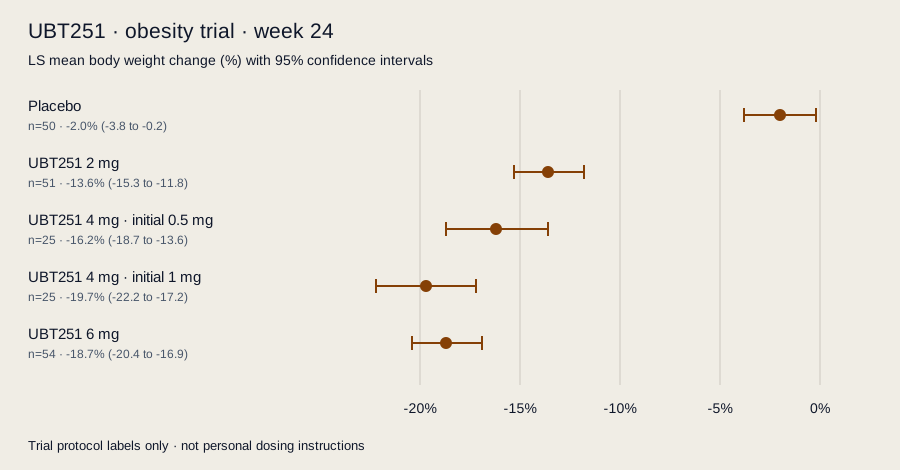
The primary endpoint was percentage change in body weight from baseline after 24 weeks. The −19.7% LS mean belongs to the UBT251 4 mg group with an initial 1 mg regimen. The −17.7% figure is a placebo-adjusted difference, not that arm’s unadjusted mean.
Reported placebo-adjusted differences ranged from −11.5% (95% CI −14.1 to −9.0) to −17.7% (95% CI −20.8 to −14.6), all p <0.001 versus placebo. These are reported model contrasts; do not reconstruct them from rounded arm means.
The 6 mg mean of −18.7% was numerically smaller in magnitude than −19.7%. The pattern is not a simple monotonic dose–response. Each 4 mg group had only 25 participants; these estimates cannot establish an optimal regimen for an individual.
Safety and unresolved questions
The paper summary describes the most frequent adverse events as mild-to-moderate gastrointestinal symptoms. That description does not establish safety for everyone or settle longer-term tolerability. The authors frame the findings as support for phase 3 evaluation, not approval.
The paper reports improvements in waist, BMI, blood pressure, lipids, and glycemic parameters. This site does not supply numerical deltas for those outcomes because they are outside the locked evidence extract. Consult the primary paper for those analyses.
Trace the evidence
The registry is NCT07177469, with Chinese registration CTR20250288. The supplied registry extract marks the study completed, with start 2025-03-14, primary completion 2025-10-22, and completion 2025-11-19. These are a recorded snapshot, not a live registry feed.
For another editorial treatment, see CT632’s UBT251 trial explainer. The original paper and registry remain the evidentiary sources.
The arm-level results
Trial protocol labels only: regimens describe study groups, not instructions for personal use.
| Trial arm | n | LS mean | 95% CI |
|---|---|---|---|
| Placebo | 50 | -2.0% | -3.8 to -0.2% |
| UBT251 2 mg | 51 | -13.6% | -15.3 to -11.8% |
| UBT251 4 mg · initial 0.5 mg | 25 | -16.2% | -18.7 to -13.6% |
| UBT251 4 mg · initial 1 mg | 25 | -19.7% | -22.2 to -17.2% |
| UBT251 6 mg | 54 | -18.7% | -20.4 to -16.9% |